
Article by: Lucie Tomanova
Thirteen-year-old Adam from Ostrava finishes his lunch, opens TikTok on his phone, and scrolls through his feed. A video about weight training pops up. Then one about healthy eating for muscle growth. Next, a motivational coach talks about discipline and the path to success—and also about how a real man must never be weak. A moment later, another muscular coach explains that women are “hypergamous,” that feminism has destroyed the family, and that emotions are only for men without money or testosterone.
Adam wasn’t searching for anything or signing up for anything. He was just scrolling. And yet, little by little, the algorithm installed a new “operating system” in his mind: a relationship is not a connection between two equal people, but a power game with rigidly assigned roles.
The attention economy that underpins most social media platforms encourages the spread of radical ideologies because it appeals directly to emotions. Fear, outrage, and the creation of an imaginary enemy or scapegoat are highly effective tools.
Women are more liberal than men
The gap between the attitudes of young men and women is not something influencers have invented; it has a real basis. John Burn-Murdoch, a data journalist at the Financial Times, described the trend in his analysis A New Global Gender Divide Is Emerging: in many countries, young women have shifted towards more liberal attitudes faster than their male peers. In some places, Generation Z increasingly resembles two separate generations rather than one. A longitudinal analysis by Glocalities, based on 300,000 questionnaires from twenty countries between 2014 and 2023, confirms the trend.
Girls are told they can study, travel, and reject relationships that don’t work for them. Boys, meanwhile, are still given the old assignment: be strong, successful, and needed. But they are expected to fulfil it without the privileges of the past and without a new guide to navigating uncertainty and rejection. Some are therefore entering adulthood in a world whose rules have changed faster than the skills and resources they have been given to deal with it.
But this is not inevitable. A study by Richard Nennstiel and Ansgar Hudde, Is There a Growing Gender Divide Among Young Adults in Regard to Ideological Left–Right Self-Placement?, published in the European Sociological Review in 2025 and based on 466,000 young adults from 32 European countries, reveals a more complex picture. In some places, the divide is widening; elsewhere, it is small or statistically insignificant. The question, then, is not whether the divide exists, but who will turn it into a chasm. And this is where the content Adam’s phone serves up comes in.
The road to self-hatred
Most videos about exercise, nutrition, and self-improvement seem sensible and harmless: “Work on yourself, bro. Hit the gym. Take responsibility for your life.”
Yet even this seemingly healthy content carries risks.
“Lots of young boys do nothing but obsess over whether food is healthy or unhealthy, how much protein and sugar it contains. They want everything to be zero-sugar, to an absolutely obsessive degree,” says psychologist Iva Poláčková Šolcová of the Institute of Psychology at the Czech Academy of Sciences. She leads MEDIS:ON, the Mediated Society research project, which examines the influence of the digital environment on society.
“They’ll happily scan their lunch with an app and announce which parts they won’t eat because they’re unhealthy. But weighing 45 kilos at 165 centimetres tall when you’re fourteen is unhealthy. The pressure on boys is just as intense as it is on girls.”
Then something shifts. A man in an expensive suit declares persuasively: “You need a winner’s mindset. Always be a leader. Never show weakness in front of anyone.” Suddenly, a man’s worth depends entirely on winning.
The next step: “If you want girls to find you attractive, you need to looksmaxx. You need a sharp, masculine jawline, muscles…”
There is no shortage of advice on how to turn a boy into a “Chad” — a fair-skinned guy with sharp features, a lean but muscular physique, and magnetic eyes. “Otherwise, no attractive girl will ever be interested in you. Got it?”
Can Adam become a Chad by spending all day moving his jaw strangely and lifting weights? Perhaps not entirely, because he has a different facial structure and a smaller build.
In short videos, emotional self-amputation gradually follows: “Emotions are for the weak. Sadness is for girls. A strong man shows only one emotion, and that’s anger.”
And just like that, we’re in the manosphere.
An imaginary hierarchy among “real men”
The manosphere is a loose network of communities, ranging from “red-pill” influencers who claim to have woken up to the truth that women are to blame for everything that is wrong, to pickup artists who teach men how to manipulate women effectively, and incels — boys and men in involuntary celibacy who want a beautiful “Stacy” but cannot have one because, they believe, they are poor and ugly. Stacy, supposedly, is reserved for an Alpha, with women like her flocking to him in droves.
In her study Alphas, Betas, and Incels: Theorizing the Masculinities of the Manosphere, Irish sociologist Debbie Ging describes a world in which men are sorted into an invented, supposedly biological hierarchy of Alphas and Betas.
An Alpha is a physically strong, handsome, dominant, and ruthless man with an expensive car and a great deal of money, usually accompanied by a collection of firearms. Beautiful young women fall at his feet. A woman is not a partner here, but a confirmation of status — just like the car.
“Love and empathy are bullshit, just tools for female manipulation.”
“A real man only wants a woman for sex and domestic services.”
The logic is unforgiving: anyone who cannot become an Alpha is condemned to scraps. Either he manipulates a woman into going on at least one date with him, or he starts hating her. And from hatred to violence is only a short step.
Five days
A team led by Kaitlyn Regehr at University College London demonstrated just how quickly algorithms can intensify this downward spiral in the study Safer Scrolling: How Algorithms Popularise and Gamify Online Hate and Misogyny for Young People.
For accounts designed to simulate vulnerable teenagers, the proportion of misogynistic content in TikTok recommendations rose from 13 to 56 per cent in just five days. Regehr describes this as the “microdosing” of extremism: broken up into bite-sized videos, it appears completely normal.
“Radicalisation rarely begins with hatred. It begins with the subtle offering of cognitive comfort,” explains political scientist Eva Klusová of the Institute of Psychology at the Czech Academy of Sciences, who also works on the MEDIS:ON project.
“A young man experiencing rejection or a sense of failure is offered an appealing answer through a radical narrative: ‘The problem isn’t you; it’s the system and women.’ Anger then replaces sadness and provides a temporary feeling of strength, which can be highly addictive for a vulnerable individual.”
A more recent study, Development and Application of the Masculinity Content Classification Framework, summarised by the University of Melbourne, analysed the actual viewing histories of 142 young men from Australia, the United States, and the United Kingdom.
It mapped a content journey that begins with a triceps workout tutorial, moves on to discussions of male status, and eventually ends at the far end of the same ecosystem: overt misogyny. There, influencers such as Andrew Tate advise boys on how to get women to create content for OnlyFans and make money from it.
Tate and his clones
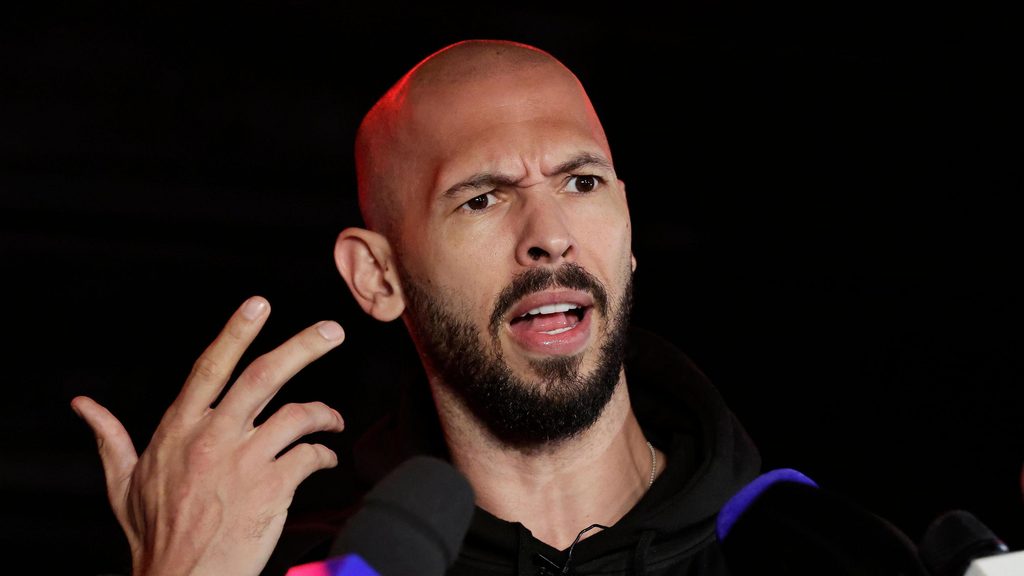
Tate himself is now more of a cautionary tale than a star. The former kickboxer, who made his fortune in the webcam business and openly describes himself as a misogynist, has been in custody in the United States since July and is fighting extradition to the United Kingdom, where he faces charges of rape and human trafficking. In early September, Romanian prosecutors also indicted him on charges of trafficking minors and money laundering. Tate denies the allegations.
Yet in his older videos, which continue to circulate on social media — including Andrew Tate Explains How to Get Girls FAST and EASY — everything he is accused of is presented as part of a winner’s lifestyle.
But the manosphere has long since grown beyond a single person. In its article Beyond Andrew Tate: The Imitators Who Help Promote Misogyny Online, The Guardian described an entire layer of imitators making money from the same formula: sexist ideas packaged as seemingly harmless advice about fitness, finances, and discipline.
It is an interconnected ecosystem. One influencer invites another onto a podcast; a third edits the most provocative minute into a TikTok clip, and the algorithm takes care of the rest. When Tate’s accounts were blocked, his fans flooded social media with compilations. His content never really disappeared.
The box below outlines some of the figures Adam is most likely to encounter first.
None of this arrives with an “extremism” label attached. It comes as a joke, a meme, or a motivational quote over footage from a gym, sandwiched between a video about protein and an UFC highlight reel. A thirteen-year-old boy has no obvious reason to stop and question it. And so he may come to believe that the ideal man is essentially a destructive sociopath.
The “game” has different endings. Some are extremist.
What will Adam take away from all this? Much depends on whether he has positive male role models around him — a father, coach, or older brother who knows how to lose, admit to being tired, and say when he feels terrible. It also depends on whether he sees them more often than he sees coaches posing beside a rented Lamborghini.
The extent to which someone is influenced by the manosphere and becomes disconnected from reality can vary in intensity and form, depending in particular on the environment in which they live.
The first possible outcome is simple apathy.
“Girls complain that boys no longer approach them. They just passively wait to see whether a girl will want them, make the effort, and seem attractive enough to them. They’re acting like little princes,” says Iva Poláčková Šolcová.
It makes sense. When someone tells you a thousand times that rejection proves you are inferior, you eventually stop trying. The fear of humiliation is also much greater today than it used to be, because any failure can end up on social media for the entire school to see.
“Lots of children and young people are completely apathetic. They don’t want anything, nothing interests them — they are mostly preoccupied with appearance,” the psychologist adds.
A more radical version is outright nihilism and giving up on everything. The blackpill community is essentially founded on hostility towards the world. Some of these adolescents may develop a desire to see society, or at least women, punished and humiliated.
Misogyny can then develop into an even darker phenomenon: a second possible path, nihilistic violent extremism. This is characterised not by any specific ideology, but by the glorification of destruction and chaos.
“Vulnerable boys who have fallen into a state of complete hopelessness end up in virtual worlds where they are manipulated into bullying, self-harm, and violence. In the most extreme cases, they find their purpose in outright destructiveness, which is supposed to make them notorious online through a horrific act,” explains Petra Mlejnková, a radicalisation researcher at the Faculty of Social Studies at Masaryk University in Brno. She is also a researcher on the MEDIS:ON project.
One of the best-known destructive communities, the 764 network, originated on Discord in 2021. It was founded by a fifteen-year-old from Texas and recruited members through gaming platforms such as Roblox and Minecraft, as well as through Telegram.
Its members, many of them minors themselves, blackmail vulnerable children and coerce them into self-harm, animal abuse, and the production of sexual material. The FBI classifies the network as “nihilistic violent extremism” and is investigating hundreds of cases, as The Guardian reported last year. In December 2025, Canada designated it a terrorist organisation.
The founder received an 80-year sentence, but the network splintered into dozens of successor groups that continue to recruit members, according to the Global Network on Extremism and Technology.
The third possible ending appears more respectable on the surface. The manosphere convinces boys that the modern world has become effeminate and lost its sense of order, then recommends “one of the traditional churches” as a cure.
In theory, this can work if the church community is a positive one. In Denmark, priests across the country have reported an unprecedented influx of young men arriving from online communities since last year, according to the newspaper Avisen Danmark in December.
In August, Kristeligt Dagblad reported on how young converts — including former members of the youth wing of Denmark’s far-right Danish People’s Party — were dividing the Russian Orthodox church in Copenhagen because of their “male-chauvinistic or somewhat fanatical” behaviour.
An Orthodox priest acknowledged in a commentary that young men were forming their ideas about Orthodoxy online, where the Church is promoted as particularly masculine, patriarchal, and misogynistic. This is precisely the image the manosphere needs — and one that suits Moscow, which generously funds its Danish churches, according to TV 2.
The fourth possible ending is classic extremist recruitment. Far-right or far-left anti-establishment groups recruit new members on Discord and Telegram, sometimes through communities linked to gaming platforms. Within a few weeks, an adolescent boy can become a “brother”, receive tasks and a role to fulfil, and be given an enemy.
How to bridge the virtual divide
The cycle closes from the other side, too. Girls who see screenshots from the manosphere and statistics about violence against women appearing in their feeds begin to fear boys and withdraw from them. Their withdrawal, in turn, reinforces boys’ feelings of rejection. Each side uses screenshots of the other to confirm its own beliefs.
“Social media traps both groups in impermeable bubbles in which they dehumanise one another,” warns Eva Klusová. “This creates a profound epistemic crisis: under the constant influx of toxic fragments of information, young people reinforce the belief that any real relationship with the opposite sex is inherently dangerous or doomed to fail.”
A boy who has learned that every emotion other than anger is a system malfunction, and that he must be an “Alpha”, may wake up at thirty in an apartment all alone — without a partner, family, or friends, and unable to call a friend to say that he is struggling.
The way out is more demanding. Adolescent boys need positive male role models: real men who are emotionally strong as well as physically strong, courageous, and constructive. Men who treat women as partners and build healthy relationships with their families, friends, and the people around them.
They also need opportunities to interact with girls in a “safe” environment.
That is why the most effective antidote is not more videos, but places where young people meet in person while doing something that isn’t a date: sports, clubs, part-time jobs, volunteering, bands, and community groups.
Neutral ground where a girl and a boy spend an hour building stage scenery or practising a relay race and casually discover that the other person is nervous, funny, tired, and ordinarily human.
No algorithm can compete with the experience of realising that the person opposite you is not a member of the “opposite sex”, but simply another human being.
Iva Poláčková Šolcová, Eva Klusová, and Petra Mlejnková collaborate on the MEDIS:ON research project (Mediated Society).
| Galerie manosféry: jména, která klukům vyskočí ve feedu jako první • Andrew Tate – A former kickboxer, self-proclaimed misogynist, and role model for the entire scene. He argues that women should “belong to men”, clean without being asked, and that rape victims bear “some responsibility”. He is currently in custody in the United States and faces rape and human trafficking charges in the United Kingdom, as well as a new indictment in Romania concerning the trafficking of minors. He denies the allegations. His video compilations nevertheless continue to circulate— Andrew Tate Explains How To GetGirls FAST and EASY. • Adin Ross – A gaming streamer and Tate associate who has repeatedly invited him onto his broadcasts. He can serve as a gateway for the youngest audiences: a boy arrives for gaming and betting content and leaves having absorbed Tate’s views on women. Ross lost access to Twitch over hateful content and now streams on Kick. Adin Ross na YouTube. • Jordan Peterson – A Canadian clinical psychologist and the scene’s more “respectable” face. He lectures on responsibility, order, and traditional masculine virtues, while also systematically attacking feminism and gender equality as political goals. For many boys, he is a first step: he comes across as academic, and The Guardian has identified him as one of the entry points to more extreme content. Jordan B Peterson na YouTube. • Sneako – A former YouTuber who followed Tate’s example and shifted towards red-pill content: all women are gold diggers, and feminism is a conspiracy. He also promotes conspiracy theories and has collaborated with far-right activist Nick Fuentes. YouTube removed his main channel for violating its rules; he continues broadcasting on Rumble and Instagram. SNEAKO na YouTube. • Hamza Ahmed – A British influencer living in Dubai with more than two million subscribers. He targets secondary-school students directly: his free Adonis Gang community is marketed as “self-improvement for high-school boys”, while his paid Adonis School costs around $500. He teaches boys how to become as physically attractive and masculine as possible — and how to “pick up” women. On Instagram, he calls himself cultleaderhamza. cultleaderhamza. Hamza na YouTube, Influencer School. • Fresh & Fit (Myron Gaines a Walter Weekes) – A podcast that presents itself as a show about “women, fitness, and finance”. In reality, it features a steady stream of women being humiliated: the hosts invite groups of women onto the show and ridicule them in front of the cameras. Gaines wrote a book titled Why Women Deserve Less. He claims that women get everything they want simply because they have a vagina. According to Media Matters, the show has repeatedly defended Tate and was banned from YouTube for hate speech. FreshandFit na YouTube. |
| Who is explaining how “all women” work to boys right now? • The fitness big brother — Starts with training and discipline but serves as an entry point to content that links muscles with dominance and entitlement to women. • The Alpha or Sigma coach — Sells status: a proper man leads, earns money, and never doubts himself. He monetises frustration through courses and paid communities. • The Red-pill strategist and pick-up artist – Claims to have uncovered the biological laws of dating. Teaches manipulation and how to “maintain the upper hand”. Debbie Ging‘s study provides a classic overview of the manosphere. • The Looksmaxxer – Measures jawlines and body fat. The milder version involves grooming and taking care of one’s appearance; the more extreme version involves obsession and self-harming practices. • The Blackpill fatalist či incel – Claims that relationships are predetermined by genetics. Turns disappointment into destiny and sometimes into hatred. The shift from milder communities towards more toxic incel and MGTOW spaces was documented in the study The Evolution of the Manosphere Across the Web, which analysed 28.8 million posts. • The MAGA borec – Expensive cars, guns, far-right views, and beautiful young women as accessories. |
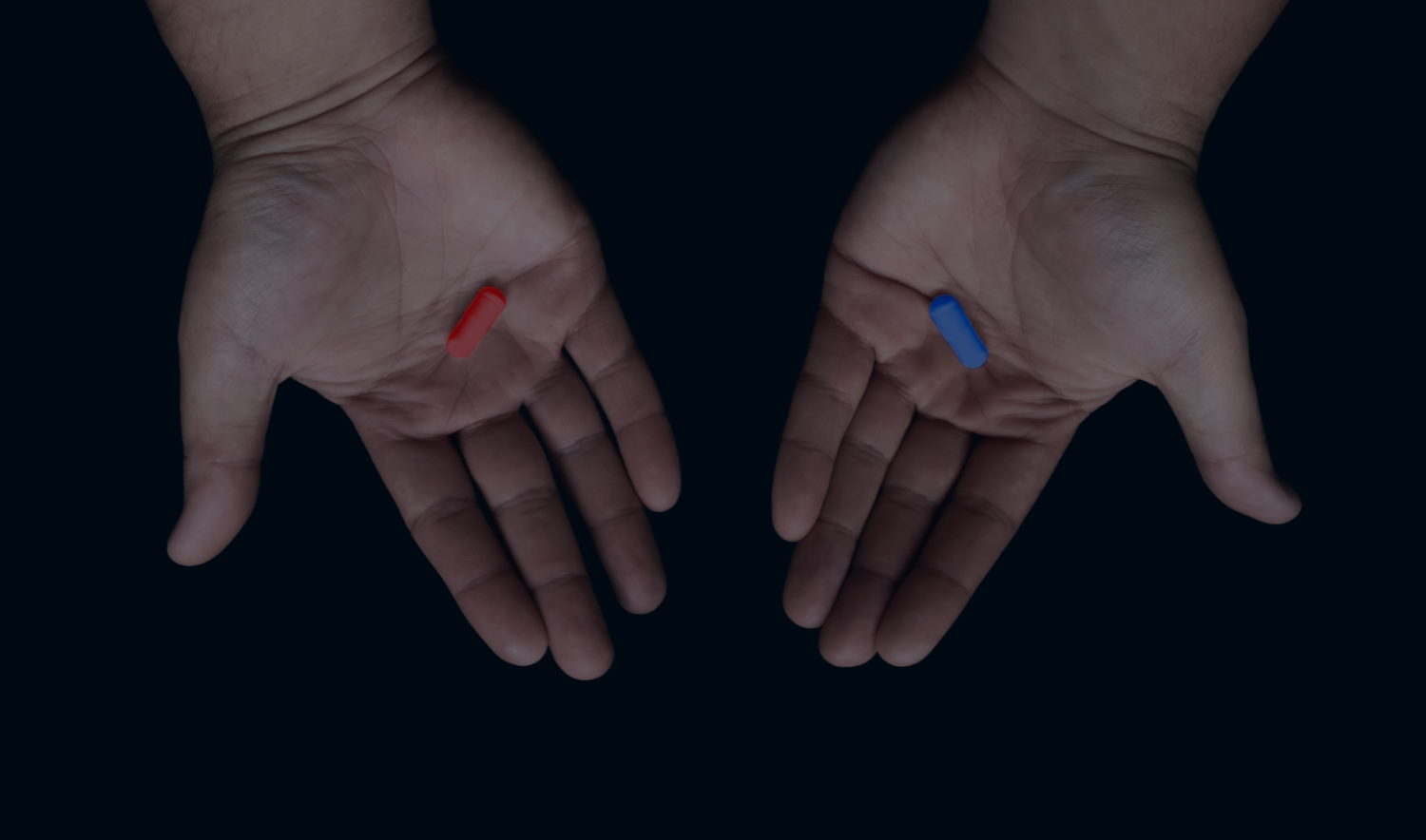
| A glossary of the manosphere • Red pill — A reference to the film The Matrix. Someone who “takes the red pill” supposedly wakes up and sees the truth: that women and feminism control the world. The blue pill, by contrast, represents someone who naively continues to believe in equality. • Alfa, beta, sigma – An invented hierarchy of men. The Alpha leads and gets everything; the Beta is a decent but subordinate “provider”; the Sigma is a lone wolf who exists outside the hierarchy. Human biology recognises no such classification. • Chad a Stacy – Caricatures of the ideal man (a sharp jawline, muscles, and confidence) and the ideal woman (beautiful, superficial, and interested only in Chads). • Hypergamy – The claim that women naturally seek partners with higher status and that ordinary men therefore have no chance. In the manosphere, it serves as a universal explanation for every rejection. • Looksmaxxing – Systematically “improving one’s appearance”, ranging from exercise and skincare to jaw exercises (mewing) and extreme practices such as breaking one’s nose or undergoing surgery. • Incel – Short for involuntary celibate, referring to a man who is involuntarily celibate. Originally a neutral term, it is now associated with a community that blames women for its members’ loneliness. • Blackpill – The darkest version of the ideology: appearance and genes have already determined your fate, so there is no point in trying. It can lead to nihilism and, in some cases, violence. • MGTOW – Men Going Their Own Way: men who have decided to exclude women from their lives entirely. • Nihilistic Violent Extremism (NVE) – A term used by the FBI for online networks such as 764. These groups have no coherent ideology beyond a cult of destruction. They recruit children through Discord, Telegram, and gaming platforms and coerce them into self-harm and violence. • Acceleracionism – A far-right belief that the collapse of society should be accelerated through violence and chaos. It is a common ideological influence in extremist communities on Discord and Telegram. |